By Nia Saunders
Gig economy is the name given to the rising phenomenon in the workforce of short-term contracts to complete short-term jobs.
While the term “gig economy” was devised during the Great Recession of 2009, freelance workers have contributed to the building of the American workforce for centuries. Freelance work is a temporary fix to someone looking for a part-time job or flexibility.

Modern day gig economy workers are usually connected with their employers on a digital platform, most commonly an app. Some examples include Uber, Airbnb and Joyrun. The process starts with a customer downloading the app, let’s say for example, Joyrun. After downloading the app, they have access to the available “joyrunners” in the area who are paid for delivering food from local restaurants, fast food places and grocery stores.
So what is so appealing to members of the gig economy? More often than not, employers of the gig economy are drawn to the flexibility of the jobs, especially when business activity is expected to vary with seasonal changes. The gig economy rests on the decision of the employees essentially selecting their gigs, how much or how little they want to work and choosing their own schedule. Members of the gig economy usually work for different companies at the same time, which may appeal to millennials who can have multiple sources of income at once.
However, with the freedom the gig economy offers to employers comes the uncertainty and uneven flow of profits. While some months may offer an abundance of business, there can be intervals where an employee may struggle to find gigs. This can be difficult when you take in to account the lack of any ability to budget and prepare for different levels of income at different times.
Another downside to working in the gig economy is the lack of benefits employees receive. Healthcare and 401k benefits are not awarded to employees hired through many of these short-term jobs. On the other hand, this means the employee’s paycheck has little to no deductions and they receive a direct income. This certainly doesn’t mean they make more than an employee in a permanent job, but they are receiving more of their earned paycheck nonetheless.
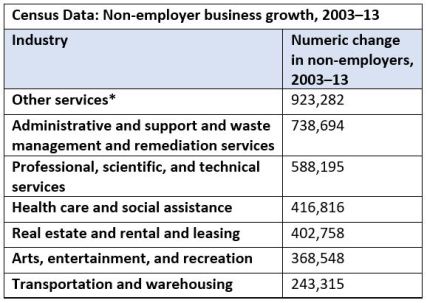 Portrayed in the chart is data from the Census Bureau between 2003 and 2013, which revealed that every sector of commerce experienced a rise in non-employer businesses. While the sector “Other services” expanded by roughly one million new non-employer businesses. These businesses provide services that range from dog walking, house repair to food delivery.
While jobs in the gig economy might lack stability, it does provide a level of freedom that permanent jobs don’t offer. Finding each gig in alignment with one’s passions can also be a strong motivating factor for joining the gig economy. With the rise of the gig economy, it is now more important than ever to understand and embrace it.
Sources:
https://www.bls.gov/careeroutlook/2016/article/what-is-the-gig-economy.htm
 sans CV
Leave a comment