By Nia Saunders

As artificial intelligence seems to be creeping its way into almost every type of business or field of work, a sense of anxiety is rising among employees worldwide. The jobs that could be affected sooner than later include manufacturing, fast-food service and transportation. This doesn’t mean that jobs such as surgeons, which require years of preparation and training, are necessarily off the hook. Technology experts are even researching ways to program artificial intelligence to complete tasks traditionally left to skillful professionals in a certain field. At the University of California at Berkeley, researchers have been studying ways to train robots to perform surgery autonomously.
Research has not yet pinpointed the exact rate in which technology will eliminate these jobs. A study from 2013 from Oxford University estimated around 47% of jobs in the United States will likely be completely automated in the next fifty years. Another account, Kai-Fu Lee, the creator of venture capital firm, Sinovation Ventures, claims AI may replace 50% of jobs in as little as ten years.
Not very far into the future, occupations once only trusted to a human, could be left at the hands of a robot. Assuming the AI is programmed flawlessly, it could perform the same task with more precision and efficiency than humans and has no need for rest, lunch breaks or time off. Aside from its upkeep and initial purchase, an AI does not need to be paid either.
While this may sound very bleak for the future of the workforce, this phenomenon is something we’ve experienced before. During the Industrial Revolution of the 19th century, the creation of many forms of automated machinery left many laborers and factory workers without jobs. For a time, many were left unemployed, but an unforeseen new wave of job opportunities soon balanced the workforce. There was no longer a need for laborers but an increased need for bankers, drivers, hospitality and retail employees, and salesmen. Taking a look back to 15th century, the invention of the printing press negated the need for scribes to copy and record writing by hand. But the printing press opened opportunities for publishers, authors, composers, and exponentially led to the spread of knowledge and research.
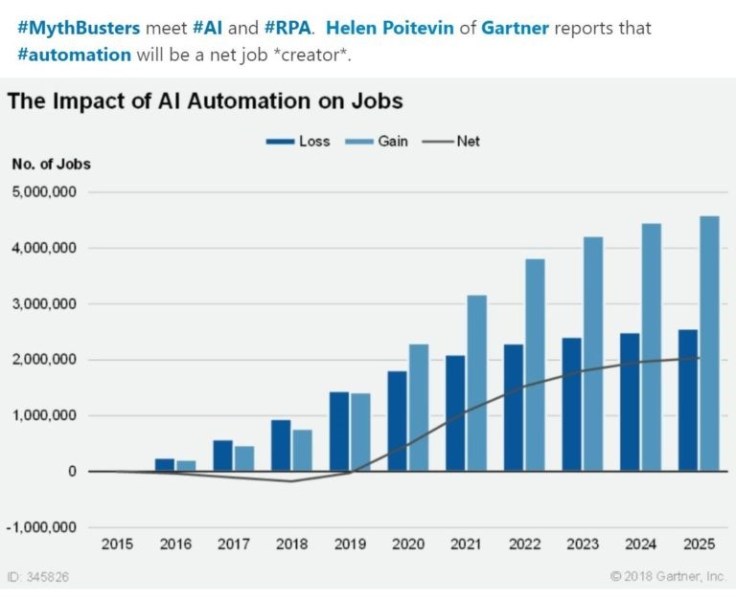
Caption: Research from Gartner, a global research firm, released new data changing their previous claim that AI would ultimately lead to the detriment of the workforce. With new evidence to back their claim, Gartner predicts AI will generate more jobs than it eliminates.
Svetlana Sicular is vice president of research at Gartner, she claims, “Significant innovations in the past have been associated with a transition period of temporary job loss, followed by recovery, then business transformation and AI will likely follow this route.” Gartner predicts that while a majority of middle and entry level positions will be replaced, a plethora new of positions with all types of skill requirement will be created.
The future of our workforce is still unsure, some argue AI will create more jobs than it eradicates. Others think it will have a complete opposite effect. However, if we look at history, we can infer that for a short time, AI may replace a portion of jobs, but it is likely to create a new wave of opportunities we are not yet able to envision.
Source for graphic:
Other sources:
https://www.economist.com/leaders/2018/03/28/the-workplace-of-the-future
 sans CV
Leave a comment